How to Use the Nano Speech Framework in Marketing to Engage, Persuade, and Convert Customers

Liam Sandford
Liam Sandford is a Head of Marketing, public speaking expert, and 2x Best Selling Author including the book Effortless Public Speaking. He helps ambitious professionals and entrepreneurs communicate with impact to get noticed, grow their career, and build their business.
Marketing is about connecting with an audience, giving them something useful, and moving them to act. Yet plenty of skilled marketers still struggle to make a complex idea land, especially in a presentation, a pitch, or the conversation that is meant to drive real growth.
The Nano Speech is how you fix that. I built it to make public speaking simple enough that anyone could do it with confidence, but the same structure works just as well in marketing, sales, and writing. Use it and a presentation lands one clear point and gives the audience a reason to act on it, instead of becoming another message they forget by the time they leave the room.
What is the Nano Speech?
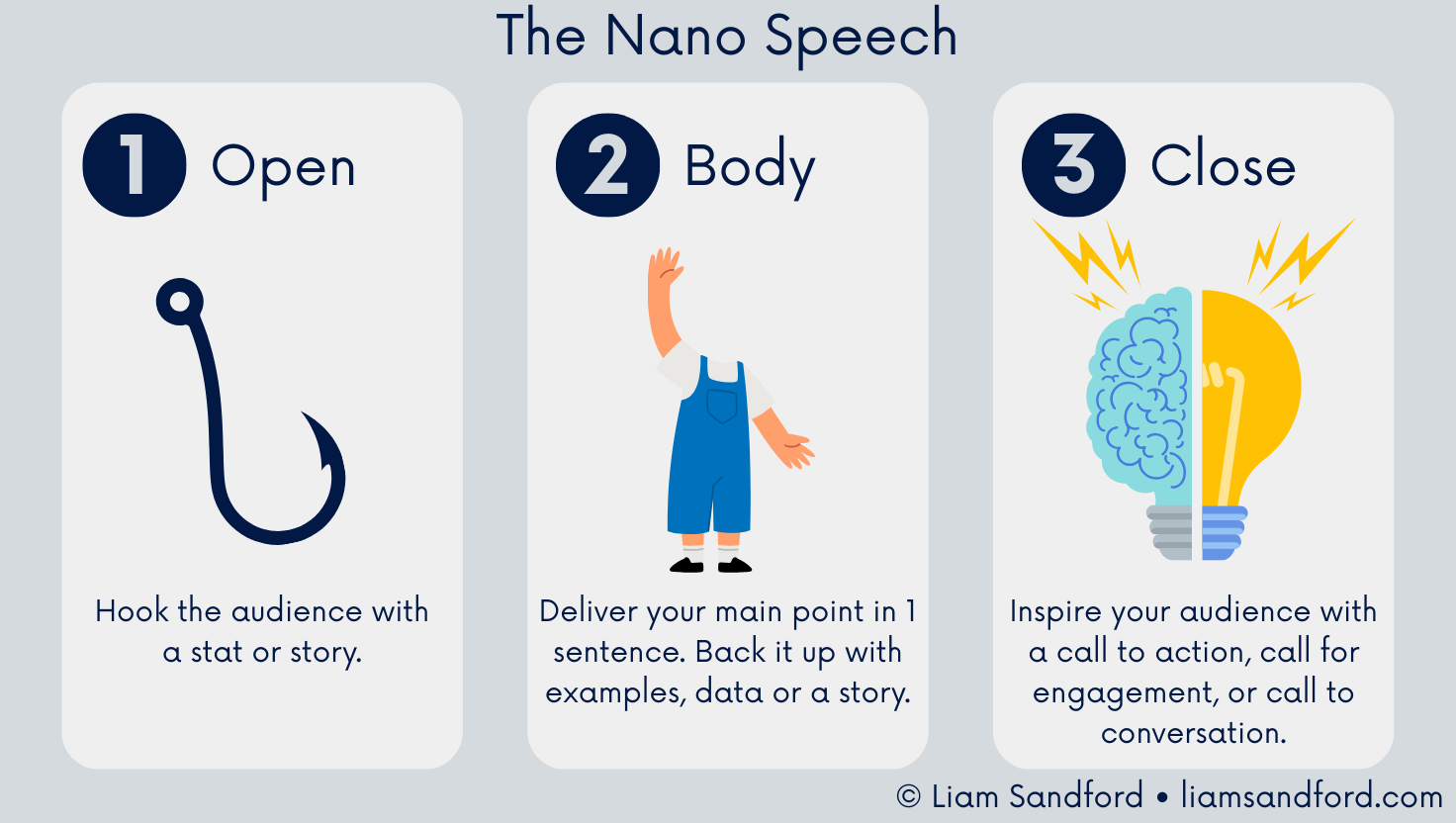
The Nano Speech is a 3 step public speaking framework that structures any message into Open, Body, Close. It keeps communication simple while doing the 3 things that actually matter: holding attention, making one point clear, and pointing the audience at what to do next.
Unlike the traditional approach that leans on agendas, repeated points and slides full of detail, the Nano Speech is built around immediate attention, one clear message, and a single action to take at the end. That makes it flexible enough for presentations, sales pitches, internal updates and everyday conversations, while keeping every one of them tied to a business goal. For a marketer, it turns every touchpoint with a prospect, client or colleague into something purposeful.
Why I Created the Nano Speech
I built the Nano Speech because I once had a real fear of public speaking and needed a way past it without throwing myself in at the deep end. It is the same structure I have used with the speakers I have coached, with marketing clients, and in my day job as a marketing leader, to take people from everyday conversations to confident presentations fast, so they can elevate their brand and communicate with impact.
Most marketers and business leaders struggle to communicate with impact, especially when speaking in front of a room. Long winded presentations, unclear messages and disengaging delivery rarely produce a measurable result.
The framework solves 3 problems at once:
Clarity: Define your main point in one sentence. If you cannot deliver it in one sentence, your audience has no chance of holding onto it. Everything else exists to back that one point up with stories, data and examples.
Engagement: Win attention from the first sentence and keep it. Skip the agenda and the long lists that send a room to sleep.
Action: End every interaction with one clear next step that moves your audience towards the outcome they want.
Used in marketing and sales, it gives every presentation and conversation a single job to do. That is how an ordinary pitch turns into something you can tie back to measurable ROI.
Using the Nano Speech in Marketing and Sales Presentations
Marketers know the hardest part of a presentation is keeping a room engaged from start to finish. The Nano Speech keeps a presentation focused on one point, which is what makes it persuasive, and positions you as a credible authority while you deliver it.
Open: Grab Attention Immediately
Start with something that sparks curiosity or hits a nerve. For example:
"70% of campaigns never hit their ROI target. Here is what the other 30% do differently."
"Imagine cutting your acquisition cost by 30% in the next 3 months."
The job of the Open is to make the audience want to keep listening. A short story, a surprising statistic, or a question that makes people reflect on their own situation all work. In a marketing presentation, that might be an industry insight they did not expect, or the common mistake most companies in the room are quietly making.
Body: Deliver Your Key Message
Deliver your one key message clearly, then expand it with examples, stories or case studies.
Show measurable results, not product features.
Use examples your audience will recognise from their own work.
Keep it concise, relevant and actionable.
Instead of listing what your software does, show how a client used it to lift lead conversion by 25% in a month. Stay clear and the audience understands faster, retains more, and is far easier to follow up with. Clarity is what puts them in a position to act.
Close: Provide a Clear Next Step
End with one specific action. For example:
Something they can do to solve the problem you have been speaking about, even if it has nothing to do with you or your product, because that is what builds trust
Downloading a resource
Making a decision on a proposal
A strong close turns the presentation into an outcome, whether that is a lead, an approval or a sale. It also reinforces your authority by handing the audience something they can use straight away. The goal of the close is simple: make the next step so obvious and easy that not taking it feels like the harder option.
Do this consistently and a presentation earns you pipeline rather than polite applause.
Using the Nano Speech When Closing Deals
Sales conversations fail when the message is overcomplicated, unfocused, or built around the product instead of the customer's problem. The Nano Speech brings the structure and clarity that let a prospect understand the value quickly and act on it.
Open: Align With Their Needs
Start by naming the challenge they actually have:
"I know your team is struggling to track campaign ROI accurately."
This shows you have listened, proves you understand their situation, and makes everything you say next feel relevant. Opening with empathy builds the trust that every sales conversation depends on.
Body: Show the Solution
Focus on how you solve their problem, and back it with a short example or case study for proof:
"Working with [another customer] we cut [metric] by 40%."
Lead with the benefit, not the feature. Keep one core message and reinforce it with evidence, and the prospect can both see the value and remember it afterwards.
Close: Drive Action
Finish with one simple, clear next step:
Agree what they need to move forward
Book a strategy session
Commit to the next conversation
The Nano Speech keeps the conversation focused and easy to act on, which cuts confusion and lifts your chances of a yes. Remember it is not about you or your organisation making the sale. It is about what the customer needs, and your job is to take the friction out of getting there.
Use this structure repeatedly and you end up with a script you can adapt for each client type and industry, so the whole team sells the same clear way rather than improvising every time.
Using the Nano Speech to Create Engaging Written Marketing Content
The Nano Speech is not only for speaking. It is the same structure your written content should follow: hook the reader, deliver one clear message, end with a CTA. Emails, newsletters, blogs and landing pages all benefit from it.
Open: Hook Your Reader
Grab attention from the first line with a headline, a question or a bold statement:
"Most campaigns fail before they launch. Here is why."
"The one framework that makes every marketing message clear."
A strong hook earns the next line, and positions you as an expert from the very start.
Body: Deliver One Core Message
Write your main point in a single sentence, then build everything else around it with examples, statistics or stories. The reader grasps the point quickly and stays with you.
Used this way, the Nano Speech makes written content scannable, so the audience takes the key message away in seconds rather than minutes. That matters most on written social platforms like LinkedIn, X and Facebook, where you are competing to be the easiest thing to read in the feed.
Close: Inspire Action
End with a CTA that points the reader at the next step:
One clear action for them to take away
Booking a call, requesting a demo, downloading a guide, or subscribing to your channel
The Nano Speech gives a piece of writing one job and one ask, which is what gets it read to the end and acted on.
Using the Nano Speech in Social Media Videos
The Nano Speech was designed to work in any speaking environment, and in its most stripped back form it can run in 10 seconds. That makes it the ideal structure for your short form video content.
Open: Hook in Seconds
Every marketer knows the first job is to hook the audience, and the Nano Speech is no different. Write a compelling hook, then test your hooks across multiple videos so you learn what actually stops your audience scrolling.
Body: Deliver One Actionable Insight
Stick to one idea per video, brought to life with a story, example or demonstration that makes it easy to remember. In the edit, add captions, B roll and sound effects so it is as engaging as it can be. In the attention economy, that polish is what keeps people watching.
Close: Encourage Action
End with a single CTA. It does not have to be about your business or capturing contact details. In fact, when the action is something they can do for themselves, you tend to build more trust and convert better over time. Vary the ask between calls to action, calls for engagement, and calls for conversation across your videos.
Apply the Nano Speech to every video and each clip earns attention on its own, turning short form content into a real marketing growth channel rather than scattered posts that move no one closer to working with you.
Where to Make Your Ask in the Nano Speech
Here is the part most people get wrong, and it is the opposite of what they are taught. The biggest ask should not sit right at the very end. Attention is the most valuable currency you have, and it is highest in the middle of your message, once you have earned interest but before people start packing up mentally and reaching for their phones. So make your real ask while you still have the room, then let the Close confirm it.
In practice that means the persuasive moment, the case study, the offer, the "here is what I would do if I were you", lands in the back half of your Body, at the peak of attention. The Close then becomes the simple, frictionless restatement of the next step rather than the first time anyone hears it. By the time you get there, the audience already knows what you want and why it makes sense for them.
This matters even more in marketing, where attention drains fast. In a video, put the call to action around the middle and reinforce it at the end, rather than gambling everything on people staying to the final second. In a sales conversation, name the next step once they have seen the value, not as an afterthought as the meeting wraps up. The Close still exists, it is just confirming a decision the audience has effectively already made.
Stacking Nano Speeches for Longer Formats
The Nano Speech is not only for short messages. For a longer presentation or webinar, stack several of them: each key point becomes its own mini Open, Body, Close, linked by short transitions, so a 30 minute session is really a series of tight, self contained messages rather than one long sprawl. That structure is what keeps attention alive across a longer format, because every few minutes you reset with a fresh hook. It also makes the content far easier to repurpose afterwards, since each stacked Nano Speech is already a standalone clip, email or post.
Frequently Asked Questions About the Nano Speech
What is the Nano Speech framework?
The Nano Speech is a 3 step communication framework, Open, Body, Close, that I created to make public speaking simple enough for anyone to do with confidence. The Open wins attention, the Body delivers one clear message backed by stories or evidence, and the Close gives the audience a single next step. It works for presentations, sales conversations, written content and short videos, and keeps every one of them tied to a clear goal.
How do you use the Nano Speech in marketing?
Apply the same 3 stages to any marketing communication. Open with a hook that earns attention, deliver one core message supported by examples or data, and make your ask while attention is at its peak before confirming the next step at the close. Used across presentations, sales pitches, emails and social videos, it keeps your message clear and consistent and makes every touchpoint deliberate rather than random.
Why does the one sentence rule matter?
Because if you cannot state your main point in one sentence, your audience cannot hold onto it. Forcing the message into a single sentence makes you decide what actually matters, and everything else, the stories, statistics and examples, then exists only to support that one point. It is the fastest way to make any message clearer.
Can the Nano Speech work for short social media videos?
Yes. In its most stripped back form the Nano Speech runs in around 10 seconds, which makes it ideal for short form video. Open with a strong hook in the first few seconds, deliver one actionable insight in the body, and close with a single call to action. Testing different hooks across videos shows you quickly what holds your audience.
Who created the Nano Speech?
I did. I am Liam Sandford, a Head of Marketing, public speaking expert, and 2x best selling author including Effortless Public Speaking. I built the Nano Speech to get past my own fear of public speaking, and I have since used it with the speakers I have coached, with marketing clients, and in my own day job as a marketing leader.
TLDR: Using the Nano Speech in Marketing
The Nano Speech framework makes every marketing communication engaging, clear and actionable.
Open, Body, Close gives you attention, clarity and action in any format.
Use it in marketing and sales presentations to educate, engage and convert.
Use it in sales conversations to simplify the message and close more deals.
Structure written content with it for clarity and persuasion.
Apply it in social media videos for attention, insight and engagement.
Make your real ask in the middle, while attention is highest, and let the close confirm it.
To learn more about how to use the Nano Speech in marketing, check out the Ultimate Guide to Public Speaking in Marketing.
More From Liam Sandford
Read my book: Effortless Public Speaking. Learn how to speak confidently, reduce stress, and turn public speaking into your competitive advantage. These actionable public speaking tips will help you improve your presentation skills for any audience.
Join the free 5-day email course: Get daily lessons packed with practical strategies to deliver effective presentations and speak confidently. This course is designed to build your public speaking skills step by step. Sign up below: