Nano Speech: The Simple Framework to Improve Public Speaking

Liam Sandford
Liam Sandford is a Head of Marketing, public speaking expert, and 2x Best Selling Author including the book Effortless Public Speaking. He helps ambitious professionals and entrepreneurs communicate with impact to get noticed, grow their career, and build their business.
The Nano Speech is a simple structure, open, body, close, that works for anything from a 10 second answer in a meeting to a full keynote. Open by grabbing attention. Deliver one clear point in the body. Close with a call to action. For longer presentations you stack several Nano Speeches together and link them with transitions. That is the whole thing, and it is the same shape whether you are speaking for 10 seconds or an hour.
I did not learn this on a stage. I built it because I used to be terrified of speaking, and every framework I was handed was too big, too rigid, or too clever to use when my heart was pounding. The Nano Speech is the tool I wish someone had given me back then: small enough to survive the fear, strong enough to carry a room.

Why I Built the Nano Speech
For years I would rather have done almost anything than stand up and speak. Not "a few nerves" nervous. Properly afraid. The kind where you rehearse an excuse to leave the room before you have even been asked to contribute.
The advice I found made it worse. Memorise your speech word for word. Picture the audience in their underwear. Fill the silence. Open with your agenda so people know what is coming. Every bit of it either added pressure or gave me one more thing to get wrong. When you already feel exposed, "here is a 12 step model for structuring a persuasive presentation" is not help. It is homework you will fail in front of people.
So I stripped it back to the smallest thing that could still work. If public speaking is really just a conversation without the pressure environment, then the structure should be small enough to use in an actual conversation. A structure I could run in my head while my pulse was going, that did not need a script, and that worked the same whether I had 10 seconds or 10 minutes. That is where open, body, close came from. I needed one shape I could trust when I could not trust myself.
The reason I am telling you this is not sympathy. It is that the Nano Speech was built from the inside of the fear, not from a stage looking down at it. Every part of it is designed to reduce the load on a nervous speaker, which is exactly why it also happens to make confident speakers clearer.
What the Nano Speech Is and Why It Works
A clear structure improves your speaking on its own, before you have changed a single word of content. It stops you wandering off the point, so the audience leaves with the value you meant to give them. Most of what people call "being bad at public speaking" is not nerves at all. It is having no shape, so you drift, over explain, and finish on "any questions?" because you never planned a real ending.
The Nano Speech fixes that by settling the three things speakers get wrong before they open their mouth: how you start, the one point you are making, and how you finish. With those locked, your attention is free for the audience instead of scrambling to work out what comes next.
It flexes to fit whatever you are doing:
Conversations: introduce a new topic or ask a question, make your point, invite a response.
Short answers and meetings: deliver a one to two minute point with an example, then hand it back.
Formal presentations: stack several Nano Speeches into a longer presentation, linked by clear transitions.
Used this way it keeps your audience engaged and your key messages memorable, because a listener can only follow a shape they can feel. Open, body, close is a shape they can feel.
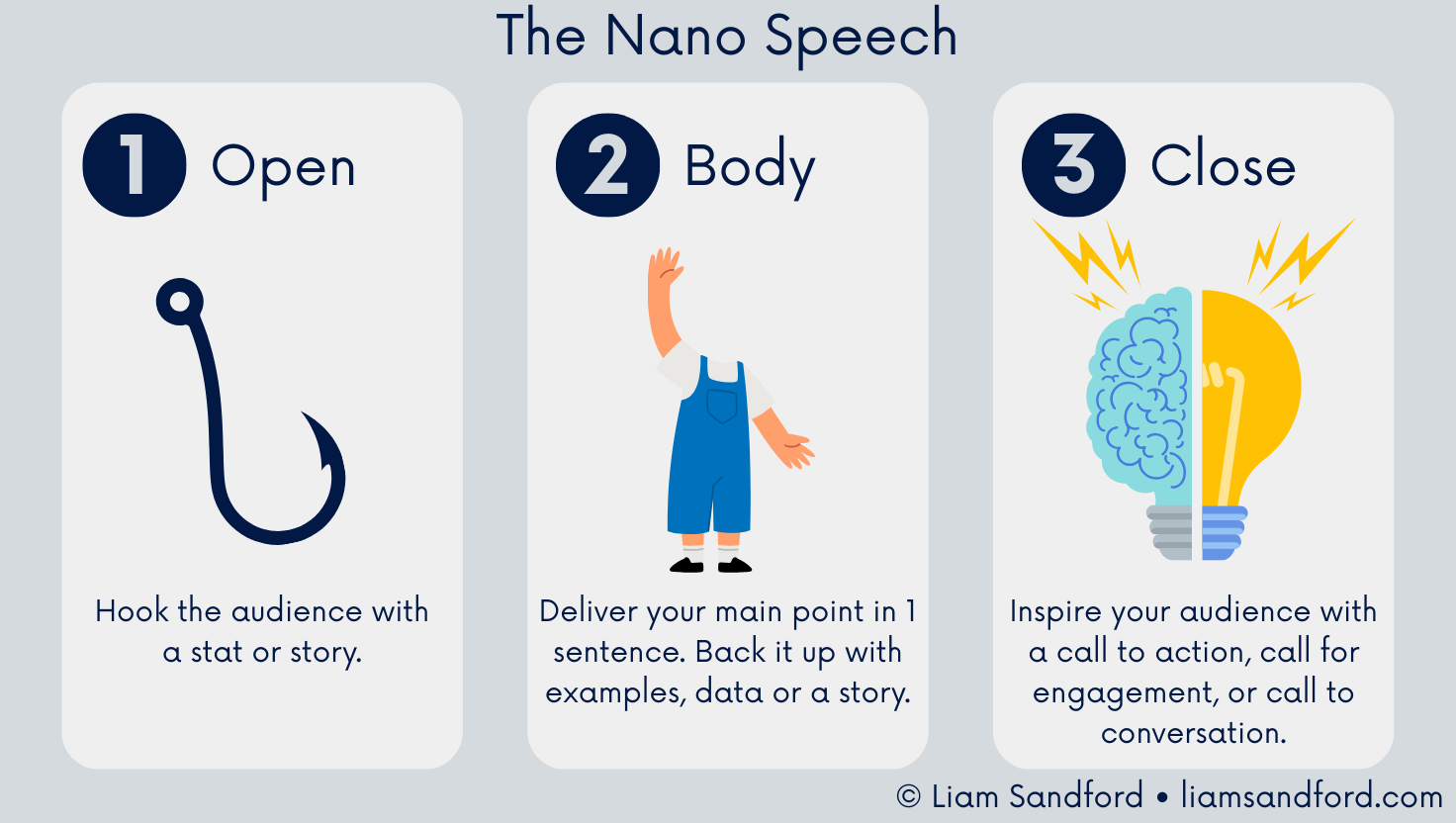
How to Use the Nano Speech: Open, Body, Close
Most speakers open with an agenda, repeat themselves in the middle, then summarise at the end. It is predictable, and predictable loses people. Here is the alternative, part by part.
Open: Grab Attention Immediately
Your opening has one job: earn the next 30 seconds. Do not spend it telling people what you are about to tell them.
In a conversation: introduce a new topic or ask a question that makes the other person lean in.
In a presentation: open with a story, name the problem your audience is really feeling, or hit them with a statistic that reframes the room.
The one thing to avoid is the agenda. An agenda gives the audience permission to think about something else, because you have just told them nothing surprising is coming. Every James Bond film opens with a set piece, not a table of contents. Do the same. Create curiosity and connection in the first sentence and the rest of the Nano Speech has room to breathe.
Body: Deliver Your Key Point in One Sentence
Here is the discipline that makes the whole framework work: your main point must fit in one clear sentence. If you cannot say it in one sentence, you are not clear enough yourself yet, and no amount of slides will hide that from the audience.
Once you have that sentence, you expand it, and only then, with a story, an example, some data, or an anecdote that makes it stick. Not three points fighting for room. One point, made memorable. This is also where clarity beats cleverness every time, because a confused audience is a lost audience, and clarity in the body is how you carry clear communication all the way through a presentation.
The order matters. Point first, proof second. If you bury the point at the end of a long build up, people are still trying to work out where you are going when you get there.
Close: End With a Call to Action
Never leave the close to chance, and never make it a summary. A repeat summary tells the audience the useful part is over and they can stop listening. Your close should do three jobs at once: signal that you are finishing, land your main point one last time, and hand over a clear next step or a question worth chewing on.
That next step can be tiny. "Try this in your next meeting." "Ask yourself who your presentation is really for." The point is that people leave with something to do, not just something they heard. Do the close well and they stay with you all the way to the end, which is exactly where most speakers lose the room.
How to Scale Your Confidence With the Nano Speech
Confidence is success remembered. It is not a personality trait you either have or you do not. It is the memory of reps you have already banked, and the most recent reps are the ones your brain recalls easiest under pressure. Which means the fastest way to feel confident on the big day is to have spoken, in some small way, very recently.
The Nano Speech is built for exactly this, because it is small enough to practise everywhere. Start with a 10 second version in a setting where nothing is at stake, and once that feels easy, scale up on one axis at a time:
Stretch the length.
Move from video calls to meetings in the room.
Widen the range of topics you will speak on.
Change one thing at a time. If you lengthen the speech, keep the setting familiar. If you move to a bigger room, keep the topic you already know cold. Throwing yourself in the deep end does not build confidence. It usually just confirms your fear, because you set yourself up to struggle and then your brain files that away as evidence you cannot do this. Start small, scale up.
The Comfortable, Confident, Competent Cycle
Comfortable: start in a safe, familiar setting where nothing is at stake.
Confident: grow the audience size or the length, once the current level feels easy.
Competent: apply the Nano Speech in longer, more formal presentations, where it now feels routine.
Scaling always starts with comfort, never with pressure. That comfort makes the Nano Speech easy to turn into a daily habit and how it fits the wider public speaking ladder: growth stays sustainable instead of terrifying.
A Real Example: 10 Nano Speeches a Day
One of the speakers I worked with was already good. Experienced, comfortable in front of a room, not somebody you would look at and think "nervous." He picked up the Nano Speech in a session and did something I did not expect. He set himself a target of 10 Nano Speeches a day.
Not 10 presentations. Ten tiny ones, each lasting anywhere from 10 seconds to a minute, most of them buried inside ordinary life. Asking a stranger for directions using open, body, close. Recommending a restaurant to a colleague with a point and a reason. Opening a meeting with a hook instead of an agenda. Ordering a coffee and structuring the small talk on purpose. None of it looked like practice, which is precisely why it worked.
What struck me was that he was already a confident speaker, and he still found the reps valuable. That is the part people miss. He was not using it to get over fear. He was using it to stay sharp, the same way a musician runs scales so the hard stuff stays easy. Skills go rusty when you leave them alone, even good ones. By stacking tiny reps into his day, his most recent speaking memory was never more than a few hours old, so he walked into real presentations warm instead of cold.
Why the Daily Reps Work
Frequent reps build confidence: speaking regularly keeps your comfort in front of people topped up, so nerves never get the room to spike.
Constant practice keeps the structure automatic: every Nano Speech drills the same open, body, close you will lean on when it counts.
Zero pressure: nobody knows you are practising when you order a coffee, so there is no cost to a rep that goes badly.
Even if you never hit 10 a day, and most people will not, the direction is right. Regular low stakes reps turn every conversation into a stepping stone towards structured, successful speaking. You do not have to book a stage to practise. You just have to notice the openings already in your day.
Stacking Nano Speeches Into a Full Presentation
The question I get most is how something built for 10 seconds carries a 40 minute presentation. The answer is that you never really build a 40 minute presentation. You build several Nano Speeches and connect them.
A longer presentation looks like this:
Open → Body → Transition → Body → Transition → Body → Close
Each body is its own complete Nano Speech: one point, one piece of proof. The transitions are the join, and they matter more than people think, because transitions are where a presentation is won or lost. A clean transition tells the audience "that point is finished, here comes the next one," which keeps momentum going. Momentum is not about speed, it is about progress, and too much context between points is the fastest way to kill it.
Think of it as a playlist rather than one long song. Five tight Nano Speeches with clean transitions will always beat one sprawling presentation that tries to say everything at once, because the audience can feel each point land and close before the next one begins. This is exactly how you scale a conversation into a presentation without ever writing a script you would have to memorise.
Actionable Takeaways
Run open, body, close every time you speak, from a passing comment to a keynote. Make it the default shape, not a tool you save for special occasions.
Before any point, force it into one sentence. If it will not fit, you are not clear enough yet, so keep refining until it does.
Bank reps daily in low stakes moments the way the speaker I worked with did. Confidence on the big day is just recent practice you can remember.
To see how the Nano Speech sits inside everything else, work through the ultimate guide to public speaking and use it to make public speaking effortless.
Frequently Asked Questions
Is the Nano Speech only for nervous speakers?
No, and the speaker who ran 10 a day proves it. Nervous speakers use it because it is small enough to survive the fear. Confident speakers use it to stay sharp and to cut the rambling that experience quietly lets creep in. The framework does not care where you are on the ladder. A beginner uses it to get through a meeting; an experienced speaker uses it to keep 40 minutes from turning into mush. Same structure, different problem solved.
What is the difference between a Nano Speech and just talking?
Just talking leaves your start, your one point, and your ending to chance, and those three are exactly where speakers drift. A Nano Speech decides all three in advance. That is not a script, it is a shape, so you still sound natural and unrehearsed. The difference shows up in how the audience receives it: with a shape they can follow you, and without one they are quietly working out when you will stop.
How is this different from the "tell them what you'll tell them" method you were taught at school?
That old method is three summaries wearing a trench coat: preview, content, recap. It wastes everyone's time by delivering the same thing three times and it opens with an agenda, which switches the audience off before you have started. The Nano Speech never previews and never recaps. It opens with a hook, makes the point once and makes it well, then closes on a next step. You say it once, properly, instead of three times, weakly.
Can I really practise public speaking without an audience?
Yes, and it is the fastest route there is. Every ordinary interaction is a hidden stage: ordering food, opening a call, giving a colleague a recommendation, answering a question in a meeting. Run open, body, close through those and you have banked a rep nobody clocked as practice. Because there is no audience judging a "performance," there is no pressure, so the reps stack up without ever feeling like practice. That is the whole trick behind 10 a day.
How long should each Nano Speech be?
One Nano Speech covers one point, so the length follows the point, not a stopwatch. A quick version lands in 10 to 20 seconds. A fuller one with a story runs a couple of minutes. As a rough guide, a single Nano Speech built for a presentation sits around five to 10 minutes, and anything longer than that is a sign you are trying to cram two points into one, which is when you should split it and add a transition instead.
TL;DR: The Nano Speech Public Speaking Framework
The Nano Speech is a single structure, open, body, close, that scales from a passing comment to a keynote.
Open grabs attention with a story, a question, or a reason to care. Never an agenda.
Body delivers one point in one sentence, then backs it up with a story, data, or an example.
Close hands over a call to action, not a repeat summary of what you just said.
Stack Nano Speeches for longer presentations: open, body, transition, body, transition, body, close.
Build confidence by starting small and scaling up, because confidence is success remembered, one banked rep at a time.
More from Liam Sandford
Read my book: Effortless Public Speaking. Learn how to speak confidently, reduce stress, and turn public speaking into your competitive advantage. These actionable public speaking tips will help you improve your presentation skills for any audience.
Join the free 5-day email course: Get daily lessons packed with practical strategies to deliver effective presentations and speak confidently. This course is designed to build your public speaking skills step by step. Sign up below: